Things to do
Most visitors to the refuge drive the 12 mile widlife drive, viewing the impoundments and other habitats from the road and exploring the several short trails and observation towers. The tour route can also be explored on foot or by bicycle.
Much of the rich diversity of wildlife in the refuge can be viewed from the roadway. Common acitivities include wildlife viewing, birding and nature photography. At certain times of year the numbers of shorebirds, ducks, egrets or Snow Geese can be overwhelming. Foxes, Beavers and Muskrats can be seen, especially early in the morning.
The earlier you come, the more wildlife will be visible. The best viewing conditions are in the morning when the tide is high. During high tide, the birds roost in the impoundments and in the morning the sun is at your back for viewing them. Drive slowly to see the most wildlife and multiple trips around the wildlife drive are often productive as the wildlife visible changes constantly.
In the summer, perpare for mosquitos and especially biting flies, which can be fierce in July and August. It is best to come on windy days in the late summer because wind suppresses fly activity. Nevertheless, much can be seen from iniside the car even when flies are bad.
Be sure to review the Visitor Information page for hours and fees.

Virtual Tour

Welcome to our virtual tour of Bombay Hook National Wildlife Refuge. You are invited to take the tour and learn about points of interest on the refuge. We hope this tour will introduce you to Bombay Hook and prepare you for your next visit.
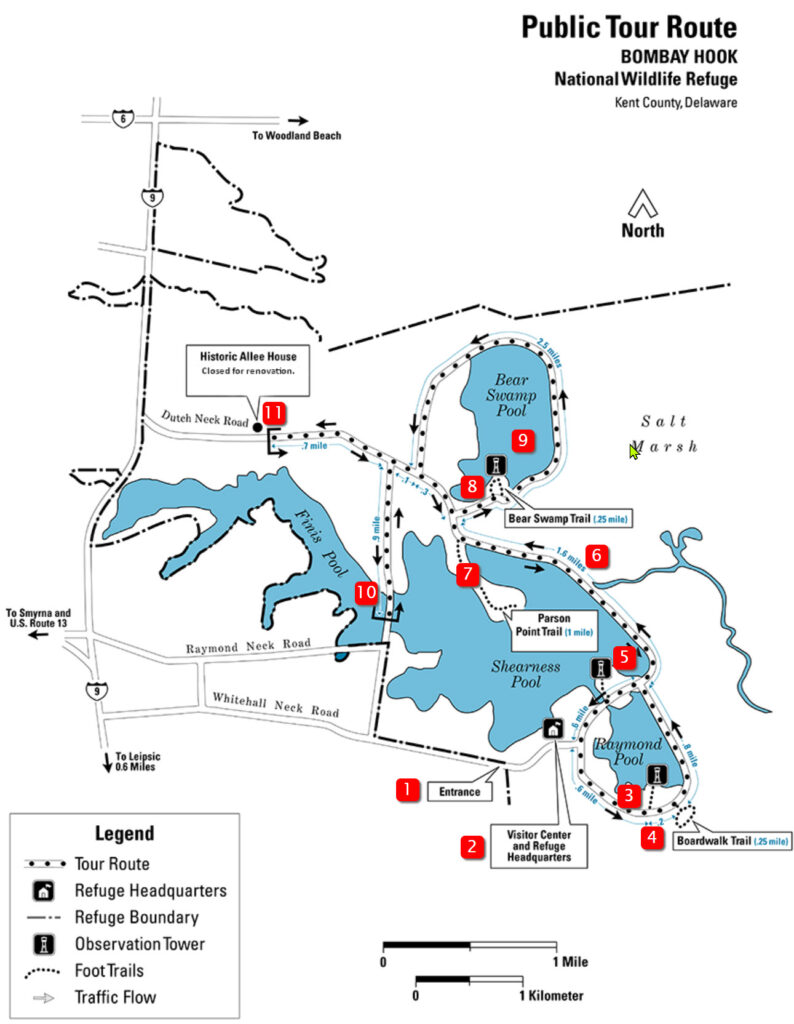
Our virtual tour will highlight eleven points of interest at the refuge. Each point of interest is marked in red on the public tour route map shown below.
The map shows the portion of the refuge covered by the public tour route, a twelve mile round trip that passes through many of the refuge habitats. The public tour route is the main artery through the refuge. Visitors may drive, walk, or bicycle it; or they may stop their vehicle along the side of the road and observe and photograph. Also marked on the map are the locations of the freshwater impoundments (shown in blue), the five refuge walking trails, and the three observation towers.
Tour Map. See below for information about each stop.
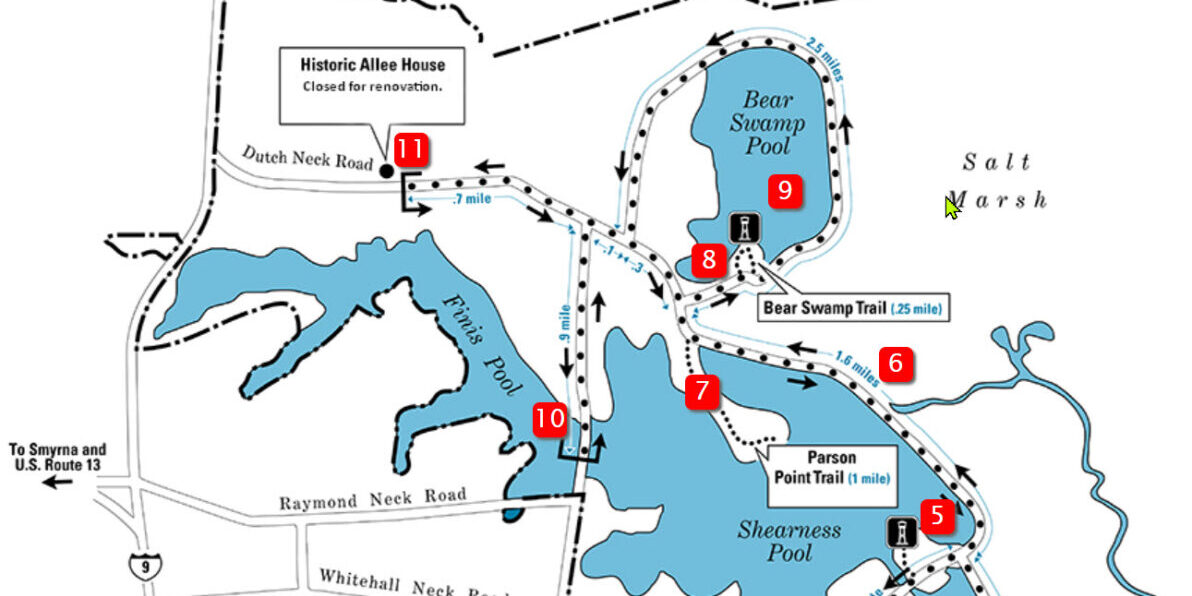
Tour Stops. Click to expand.
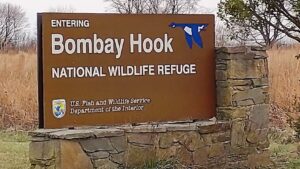 Welcome to Bombay Hook National Wildlife Refuge. The refuge covers about 16,000 acres in central Delaware along the western shore of the Delaware Bay.
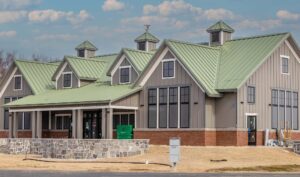 The headquarters building houses the Visitor Center, the Refuge Store, and the offices of the U. S. Fish and Wildlife Service staff.
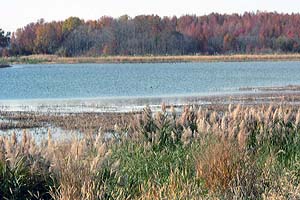 Raymond Pool is one of the four refuge freshwater impoundments, which are shown on the tour map in blue. It was the first impoundment to be created. The dike and the water control structures were built by the Civilian Conservation Corps, a work relief agency created by the federal government. Work began in 1939 and was completed in 1940.
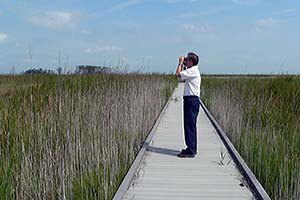 The Boardwalk Trail is about 0.5 mile long and was built in 1973 by members of the Youth Conservation Corps. It was renovated in 2010 and is now handicapped-accessible. This trail offers the visitor the only opportunity to study the tidal salt marshes that cover eighty percent of the refuge and that are among its most important assets.
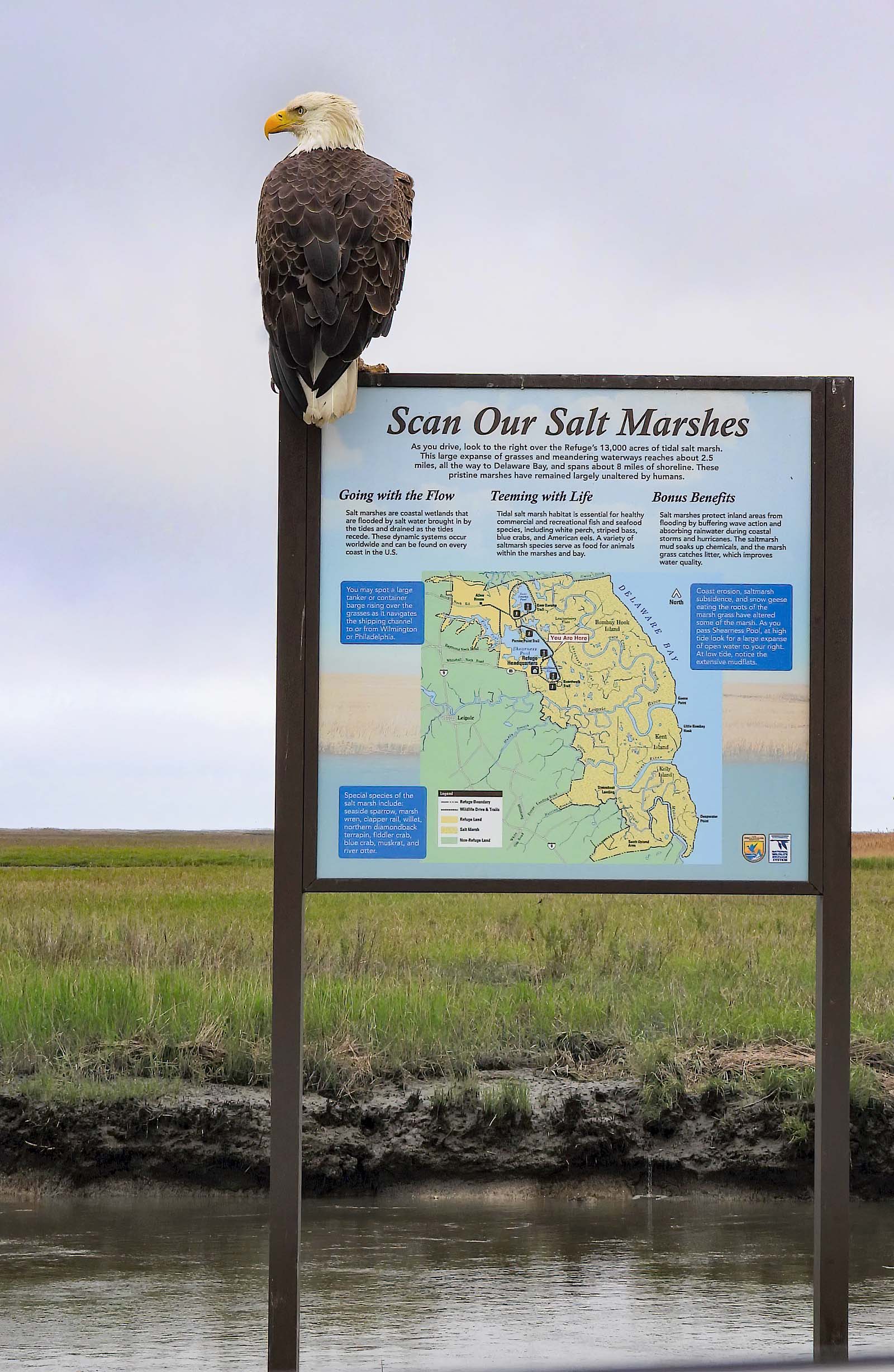
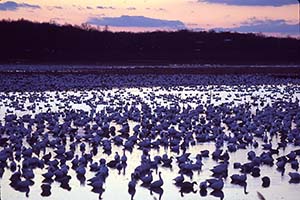 Shearness Pool is the largest of the four freshwater pools. It is the most likely area on the refuge to see bald eagles, which often nest in the woods behind the pool.
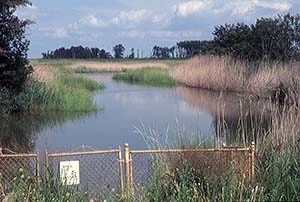 Approximately 80% of the 16,000 acres of Bombay Hook is tidal salt marsh. The refuge has one of the largest expanses of nearly unaltered tidal salt marsh in the mid-Atlantic region. It is considered to be one of Delaware's most valuable habitats.
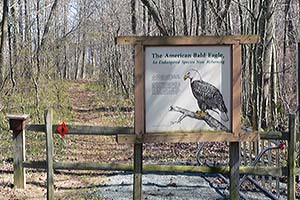 The Parson Point Trail is a one mile round trip through an isolated woodland forest. The forest is situated on a spit of land surrounded on three sides by Shearness Pool.
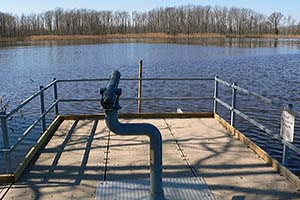 The Bear Swamp Trail, a one quarter mile loop, is located at the south end of Bear Swamp Pool. From the parking area, the trail runs north following the shoreline of the pool to a floating observation deck equipped with a spotting scope, and then to a 30 foot high observation tower, which provides a superb view of the southern reaches of Bear Swamp Pool. The trail makes its way back through a hardwood forest.
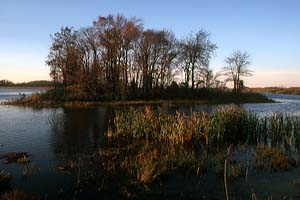 Like the other impoundments, Bear Swamp Pool is used throughout the year by many bird species.
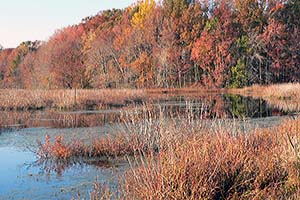 Fed by Finis Branch, the primary fresh water source for all of the refuge impoundments, Finis Pool contains the freshest water found on the refuge.
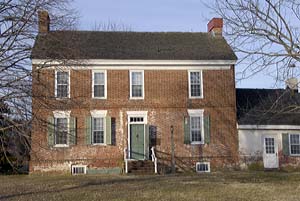 The Allee House was built in the mid 1750's by Abraham Allee, a prominent figure in Kent County political life. It is considered to be one of the finest examples of an early brick farmhouse in Delaware.
Restrooms: Handicapped-accessible facilities located at the Visitor Center are open 24 hours a day. Additionaly, toilets are located at Bear Swamp Trail and Pasture Point Pond.
Food and Drink: Food and drink are not available at the refuge. The nearest store is about six miles away.